

SystemLabs Sermorelin Review 2026: Pricing, Pharmacy & Pros
Lab-driven sermorelin and peptide protocols for performance and longevity
In a Nutshell
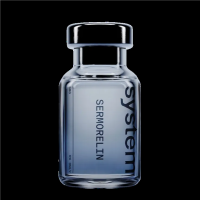
SystemLabs[1] offers compounded sermorelin in both injectable and oral dissolving tablet (ODT) forms[2] through a 100% online consultation with a certified U.S. pharmacy, 3rd-party lab testing, and free 2-day shipping[1].
Pros & Cons
Pros
- Requires baseline IGF-1 before prescribing — clinically correct approach
- Advanced peptide stacking options available
- Performance and recovery-focused protocol design
- Transparent lab-based dosing adjustments
Cons
- More intensive onboarding than simpler platforms
- Not ideal for patients seeking a fast start without labs
Overview
SystemLabs[1] is a telehealth platform offering compounded sermorelin in both injectable and oral dissolving tablet (ODT) delivery forms[2]. The platform positions sermorelin under the headline "Build lean muscle, recover faster, and sleep deeper," with the mechanism framed as signaling the body to produce more of its own growth hormone rather than introducing synthetic HGH.
Sermorelin is priced at $219 per month with a $109 first-month introductory rate[1]. The plan includes everything needed to administer the medication, ongoing clinician support, and free 2-day shipping[1]. SystemLabs explicitly states no insurance is required[1] and the entire intake and prescribing process is conducted online.
The intake is positioned as "Personalized Care, 100% Online"[1] with prescribing decisions made by the platform's medical team. The mechanism framing on the SystemLabs page is clinically consistent with the published literature: sermorelin stimulates the pituitary to release GH in a natural, pulsed rhythm, which supports lean muscle, post-workout recovery, and deeper sleep cycles[1].
For patients who want a measurable response framework, a baseline IGF-1[3] reading at intake and a 90-day retest is the standard objective monitoring approach. SystemLabs does not list specific lab requirements on its sermorelin product page; patients should confirm what bloodwork is part of their intake during the consultation.
Pharmacy and Compound Quality
SystemLabs states the sermorelin is compounded by a certified U.S. pharmacy[1] and is high-potency, 3rd party lab tested[1]. The third-party testing covers active-ingredient concentration. This is the standard testing scope for compounded sterile preparations under USP General Chapter 797 sterility[4] and USP General Chapter 85 endotoxin[5] requirements.
Beyond the testing scope listed on the product page, SystemLabs does not publish batch-level Certificate of Analysis documentation publicly. Patients who want batch-specific potency, sterility, and endotoxin records should request the COA for their lot from the dispensing pharmacy at intake.
Both injectable sermorelin and Sermorelin ODT (oral dissolving tablet)[2] are listed as separate treatments. The ODT form absorbs sublingually and bypasses first-pass hepatic metabolism, giving patients a non-injection delivery option. Dose equivalence between the two forms should be confirmed with the prescribing physician.
Protocol and Dosing
SystemLabs sermorelin protocols follow standard subcutaneous dosing for the injectable form at bedtime, when the body's natural GH pulse peaks during slow-wave sleep. The exact dose is set by the prescribing physician during the online consultation[1] based on the patient's clinical profile.
Plan inclusions on the SystemLabs product page list everything needed to administer the medication plus ongoing clinician support[1]. Dose questions and adjustments are handled through the clinician support channel rather than requiring separate appointment-based follow-ups for routine changes.
For patients who want to amplify the GH response beyond what sermorelin monotherapy produces, the SystemLabs sermorelin product page does not list ipamorelin or CJC-1295 as add-on options. Patients seeking those combination protocols should confirm availability directly with the SystemLabs clinical team or consider providers whose product pages list combination peptide protocols explicitly. Ipamorelin is the preferred GHRP because it does not raise cortisol or prolactin[6]; CJC-1295 extends the GH-stimulating half-life[7].
What to Expect
Sleep architecture improvements are typically the first reported outcome. The SystemLabs product framing of deeper, more restorative sleep cycles[1] aligns with the clinical literature on GHRH-analog therapy and slow-wave sleep.
IGF-1 retest at the 90-day mark gives the physician the first objective measure of GH axis response. Energy and recovery improvements are the most commonly reported subjective changes at this stage.
Body composition changes become measurable. Lean muscle support and recovery improvements accumulate gradually over this window.
Patients continue on the protocol with ongoing clinician support[1] for dose adjustments and refill timing.
Who Qualifies and What Intake Involves
SystemLabs operates a 100% online intake[1] with no insurance required[1]. Patients complete the consultation and the platform's medical team determines whether sermorelin is appropriate.
Patients with recent baseline IGF-1[3] results from an external lab can submit them during the consultation to support the physician's evaluation. The SystemLabs sermorelin product page does not explicitly require a baseline panel ordered through the platform.
Patients who want only basic sermorelin monotherapy without additional peptides will find SystemLabs a clean fit. Patients who want documented combination protocols with ipamorelin, CJC-1295, or BPC-157 should confirm availability directly with the clinical team since these are not listed as product options on the sermorelin page.
What Stands Out
The Sermorelin ODT (oral dissolving tablet) option[2] alongside the injectable gives SystemLabs one of the few non-injection delivery forms in this comparison. For patients who prefer not to inject, the ODT is a meaningful alternative to a pure injection protocol.
The combination of no insurance required, 100% online care, high-potency third-party lab testing, and free 2-day shipping[1] positions SystemLabs as a consumer-friendly clinical platform with a clear delivery and quality structure.
What's Included
- Baseline IGF-1 testing included before sermorelin is prescribed
- Sermorelin stacked with BPC-157, ipamorelin, or CJC-1295 on indication
- Protocols designed for performance, recovery, and longevity goals
How It Works
Order your [baseline IGF-1](https://pubmed.ncbi.nlm.nih.gov/9141536/) panel through SystemLabs before any prescription is issued.
A physician reviews your lab results and designs a protocol matched to your goals and baseline data.
Receive your peptide protocol and check in at 90 days with a follow-up IGF-1 panel to assess dose response.
Pricing
Customer Support
Lab results, protocol tracking, and provider messaging
Clinical team available via email
Bottom Line
SystemLabs is a strong fit for patients who want a clean, consumer-friendly sermorelin program with a clear delivery and quality structure. The no-insurance-required online intake, ongoing clinician support, and 3rd-party tested compounded medication[1] cover the core needs of most first-time and returning patients. The dual injectable and ODT offering gives a delivery-form choice that few comparable platforms provide.
Visit SystemLabsFrequently Asked Questions
What delivery forms of sermorelin does SystemLabs offer?
SystemLabs lists sermorelin injection and Sermorelin ODT (oral dissolving tablet)[2] as separate treatments. The ODT absorbs sublingually, giving patients a non-injection delivery option. The prescribing physician confirms which form is appropriate during the online consultation. Patients who want documented multi-peptide combination protocols listed publicly should confirm availability directly with the clinical team.
Does SystemLabs require IGF-1 testing before prescribing?
The SystemLabs sermorelin product page does not list a mandatory baseline IGF-1[3] panel as a precondition for prescribing. Prescribing decisions are made through the 100% online consultation with the medical team[1]. Patients who want a measurable baseline can request IGF-1 testing during the consultation or submit recent results from an external lab.
Who is SystemLabs best suited for?
SystemLabs is built for patients who want a clean online sermorelin program with both injectable and ODT forms available, ongoing clinician support included, and a certified U.S. pharmacy with 3rd-party lab testing[1]. Patients seeking documented multi-peptide stacking protocols listed publicly may prefer a provider whose product pages explicitly list those options.
How does SystemLabs approach dose adjustments?
Dose adjustments are made by the prescribing physician based on patient-reported outcomes and any baseline IGF-1[3] testing the patient arranges. The ongoing clinician support included with every plan[1] handles routine dose questions without requiring separate appointment-based follow-ups.
Where is SystemLabs sermorelin compounded?
SystemLabs sermorelin is compounded by a certified U.S. pharmacy and is high-potency, 3rd party lab tested[1]. The active-ingredient concentration is verified through third-party testing. Sterility and endotoxin requirements follow USP General Chapter 797[4] and USP General Chapter 85[5] standards for compounded sterile preparations.
What does the IGF-1 baseline test actually measure?
IGF-1 (insulin-like growth factor 1) is produced by the liver in response to GH stimulation. It is the standard clinical proxy for GH axis activity. A fasting IGF-1 blood test gives the physician a snapshot of the GH axis output over the preceding days. Values below the age- and sex-adjusted reference range indicate GH axis decline that may respond to sermorelin. The baseline result also sets the reference point for measuring sermorelin's effect at the 90-day retest.
How fast can I start a sermorelin protocol with SystemLabs?
After the 100% online consultation[1] confirms the prescription, medication ships from a certified U.S. compounding pharmacy with free 2-day shipping[1]. Patients with recent baseline IGF-1[3] results from an external provider can submit them during the consultation to support the physician's evaluation.
Is ipamorelin or CJC-1295 better paired with sermorelin?
Ipamorelin and CJC-1295 address different aspects of GH axis stimulation. Ipamorelin is a GHRP that amplifies GH pulse amplitude without raising cortisol or prolactin[6]. CJC-1295 is a GHRH analog with a half-life of 6 to 8 days[7], used for less-frequent dosing. The two are often prescribed together with sermorelin to stimulate GH release through two complementary pathways. SystemLabs' sermorelin product page lists sermorelin as a standalone product; patients seeking combination peptide protocols should confirm availability directly with the clinical team.
References
- Sermorelin: product page (pricing, plan inclusions, online intake, certified U.S. pharmacy, 3rd-party lab testing, free 2-day shipping, ongoing clinician support) systemlabs.com, 2026. https://www.systemlabs.com/treatments/sermorelin
- Treatments: product catalog (Sermorelin injection and Sermorelin ODT) systemlabs.com, 2026. https://www.systemlabs.com/treatments
- Endocrine and metabolic effects of long-term administration of [Nle27]growth hormone-releasing hormone-(1-29)-NH2 in age-advanced men and women J Clin Endocrinol Metab, 1997. PMID 9141536. https://pubmed.ncbi.nlm.nih.gov/9141536/
- USP General Chapter <797> Pharmaceutical Compounding: Sterile Preparations USP, 2022. https://www.usp.org/compounding/general-chapter-797
- USP General Chapter <85> Bacterial Endotoxins Test USP, 2023. https://www.usp.org/harmonization-standards/pdg/general-methods/bacterial-endotoxins
- Ipamorelin, the first selective growth hormone secretagogue European Journal of Endocrinology, 1998. PMID 9849822. https://pubmed.ncbi.nlm.nih.gov/9849822/
- Prolonged stimulation of growth hormone (GH) and insulin-like growth factor I secretion by CJC-1295, a long-acting analog of GH-releasing hormone, in healthy adults J Clin Endocrinol Metab, 2006. PMID 16352683. https://pubmed.ncbi.nlm.nih.gov/16352683/